My research interests lie at the intersection of communications, signal processing, machine learning, and network
information theory, with a particular focus on sixth-generation (6G) radio access technologies, cyber-physical security, and medical imaging.
I am dedicated to exploring the mathematical limits of sensing, storage, and communication and leveraging these insights to advance the design
of smart sensing and communication networks. A key aspect of my recent work involves employing mathematical and learning-based tools to uncover
these fundamental limits and developing practical methods to implement them in real-world scenarios.
We test our algorithms rigorously using software-defined radios (SDR) in the WIN Labs
as well as on large-scale NSF platforms, ensuring practicality of solutions.
Research
Selected Projects
I have worked on several projects on large-scale wireless systems (including mobile and sensor networks) in collaboration with
leading companies to design/optimize real-world complex systems. Some of my research
projects, together with a statement of their potential impacts, are outlined below.
CAREER: Harnessing Interference with Deep Learning: Algorithms and Large-Scale Experiments
National Science Foundation, 2023-2028
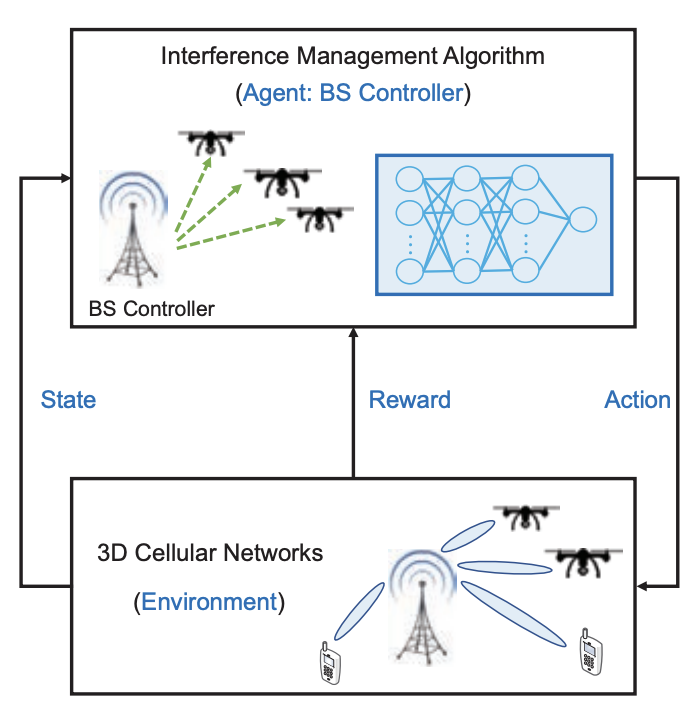 |
The implementation of this research involves developing and testing the proposed algorithms on the NSF POWDER and AERPAW platforms, which are large-scale experimental testbeds for advanced wireless research. The project will simulate real-world network environments, ensuring the algorithms are robust and scalable. By integrating cutting-edge machine learning models with practical system design, this research bridges the gap between theory and application, paving the way for intelligent interference management in real-life cellular networks. |
Collaborative Research: NSF-AoF: AI-assisted Waveform and Beamforming Design for Integrated Sensing and Communication
National Science Foundation, 2024-2027
 |
|
ERI: Interference-Aware Constellation Design for NOMA
National Science Foundation, 2023-2025|
SDR-based implementation of NOMA |
The project focuses on a novel learning-based digital modulation design to mitigate inter-user interference in non-orthogonal multiple access (NOMA) systems. Specifically, it explores innovative superimposed constellations for NOMA, dynamically adapting to varying interference levels to reduce bit-error rates and minimize communication latency. The findings are expected to significantly impact both academic and industrial communities, providing opportunities for undergraduate involvement in deep learning for communications and contributing to the development of graduate-level coursework. Interference cancellation is a critical component of non-orthogonal systems. In this experimental work, we implemented a downlink, two-user NOMA system, where the user with stronger channel gain employs successive interference cancellation (SIC). This work aims to develop SIC-free decoding, as an alternative. The system was deployed on an NI USRP-2974 wireless testbed to evaluate its practical spectral efficiency. Experimental results in a real-world building environment demonstrate that NOMA improves spectral efficiency by approximately 1 bit/s/Hz compared to orthogonal multiple access (OMA). |
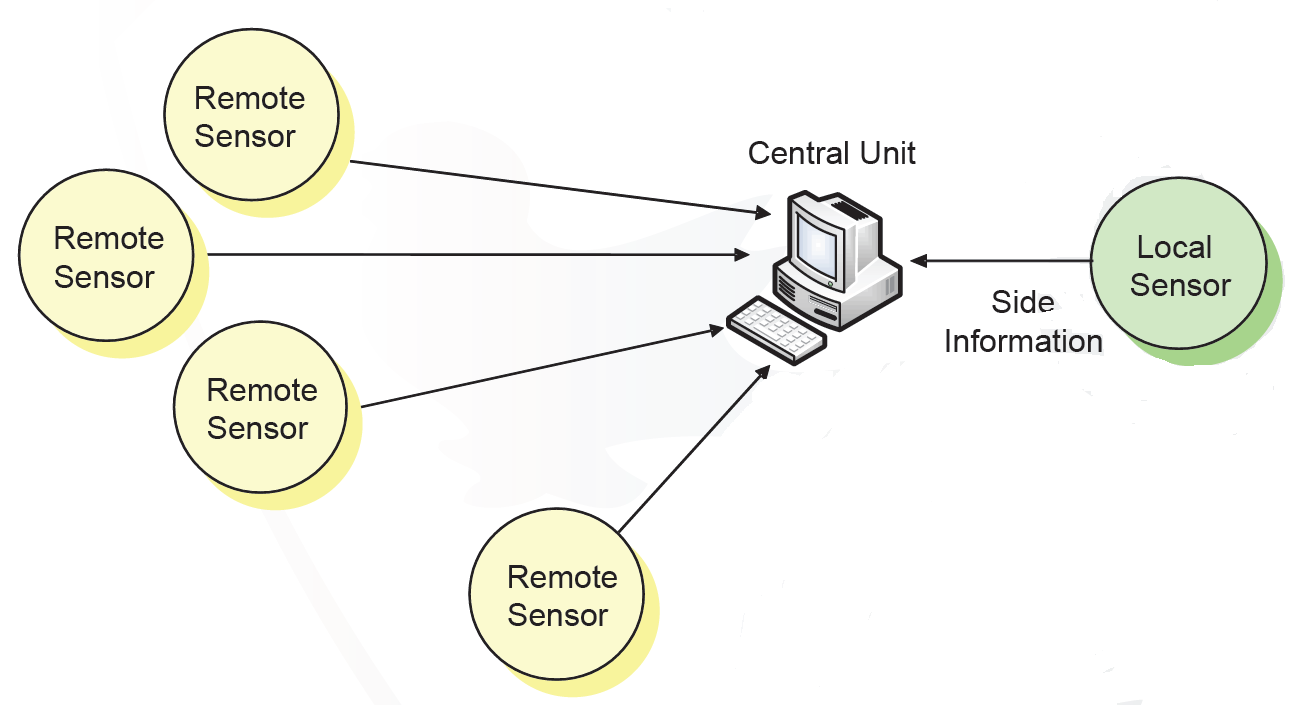
Transmission Strategies for Sensor Networks
|
|